
 IFRS S1 & S2 AlignedHRDC ClaimableDisclosureOS
Campaign Overview
The Vision of Carbon Negative 2040
IRGA Advisory's campaign “Carbon Negative 2040” is a vision, outlining a commitment to remove more carbon from the atmosphere than is emitted, moving beyond traditional net‑zero targets for the palm oil sector. For the palm oil industry specifically, this target is not merely aspirational; it is achievable through coordinated action across cultivation, milling and downstream processing, especially when shifting away from conventional palm oil practices that generate significantly higher GHG emissions than sustainable production. The baseline for comparison is stark: even sustainable conventional operations still emit approximately 0.634 Mt CO2eq per metric tonne of crude palm oil (CPO) when mills utilise biomass and biogas for energy generation, and this is why, using technology and domain expertise, the organisation expresses confidence in transforming all plantations to carbon negative by the year 2040.
The Carbon Negative Equation
Why carbon negative plantations command a premium

Malaysia has committed to reducing greenhouse gas emissions intensity by 45% of GDP by 2030, with aspirations to achieve net-zero by 2040. Using technology and domain expertise, we are confident of transforming all plantations to carbon negative by 2040.

"The data gap between what companies know and what they can disclose is real and significant. Building data infrastructure is an 18-month-minimum project. Group 2 companies that start this in late 2026 will not be ready in time."
Malaysia IFRS S1 & S2 · Year One Results
What Group 1 filings revealed for your 2026 filing
The ESG Disclose Knowledge Hub reviewed all ~130 Group 1 sustainability statements (FY2025). Eight critical findings from Malaysia's first-ever ISSB reporting cohort — and what each means for your 2026 filing:
Finding 01 · Strength
Governance was the standout strength
Committee structures, Board oversight and sustainability working groups were consistently the most well-disclosed area. Group 2 companies can use Group 1 governance filings as structural templates.
Finding 02 · Critical gap
Financial quantification was the biggest weakness
Most submissions described climate-related financial impacts qualitatively only, citing commercial sensitivity. This is the area regulators will scrutinise most sharply in subsequent periods.
Finding 03 · Methodology
Scenario analysis ranged from basic to best-in-class
Quality spanned from a single qualitative scenario to three IPCC scenarios modelled at asset-coordinate level. One scenario is not scenario analysis — it is assumption confirmation.
Finding 04 · Differentiator
Capability building was the defining differentiator
Companies that produced investor-grade disclosures had invested in understanding the standards at a technical level. Around 40% included voluntary assurance — built on auditable data trails developed well in advance.
Finding 05 · Direct requirement
SASB Standards widely overlooked
Fewer than half of submissions documented their SASB assessment — a direct IFRS S1 requirement. Regulators are expected to scrutinise this closely in subsequent periods.
Finding 06 · Process gap
Materiality processes were often thin
Double materiality assessments were rare. Many filings described outcomes without evidencing the process, stakeholder engagement or Board validation steps required under IFRS S1.
Finding 07 · Sector exposure
Physical risk treatment was uneven by sector
Asset-heavy companies addressed physical risk substantively. Asset-light companies underestimated their exposure through supply chains, premises and workforce — a particular gap for plantation businesses.
Finding 08 · Investor signal
Voluntary assurance sent a clear signal to investors
Investors and analysts are already distinguishing between companies with externally validated emissions data and those without. Mandatory limited assurance arrives for Group 2 in FY2028. The gap to build toward it starts now.
Critical: You cannot retro-calculate an audit trail. Scope 1, 2 and 3 data systems, trained people, and validated reporting processes must be built now — well before the reporting deadline, not after it.
Why Plantations Are Different
For palm oil, the regulatory overlap is financially material
IFRS S2 and the EU Deforestation Regulation create overlapping disclosure obligations — both require demonstrating that operations do not contribute to deforestation. Peatland and land-use change data, Scope 1 emissions from milling operations, and water consumption figures must be auditable, not estimated retrospectively.
Sustainable palm oil operations with biogas and biomass energy generation emit approximately 0.634 Mt CO₂eq per metric tonne of CPO. The path to carbon negative requires systematically closing that gap — and documenting every step in a way that survives external assurance.
The Reporting Timeline
Where your organisation stands right now
FY 2025
FiledGroup 1 mandatory — IFRS S2 + climate S1 items
~130 Main Market issuers (market cap ≥RM2bn) completed Malaysia's first-ever ISSB filings. Year One results are now public.
FY 2026
NowGroup 2 begins — IFRS S2 + climate S1 items
~400 remaining Main Market issuers must report from January 2026. First reports due early 2027. The reporting period has already started.
FY 2027
Full IFRS S1 and S2 — all Main Market companies
Complete disclosure standard applies. Scope 3 ATR relief expires for Group 1. Supply chain capability takes years to build.
FY 2028
Mandatory limited assurance — Group 2
External validation of Scope 1 and 2 becomes mandatory. Companies building auditable data trails now will be ready. Those who don't start now, won't be.
How IRGA Advisory Can Support Your Journey
End-to-end ESG support built for plantation businesses
IRGA Advisory brings deep plantation domain expertise together with a full suite of training, advisory and technology capabilities — giving your organisation everything it needs to meet IFRS S1 and S2 requirements, build investor-grade disclosures, and reach carbon negative by 2040.
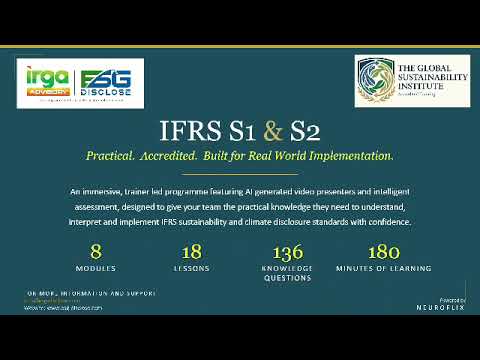
IRGA Advisory IFRS S1 & S2 eLearning Programme ▸ Watch on YouTube

IRGA Advisory Consultancy — from agronomic and operational challenges to management transformation
Carbon Management Platform ▸ Watch on YouTube
Find out where your plantation stands
Leave your details and our team will arrange a complimentary ESG Readiness conversation — no obligation, within 2 business days.
Thank you.
We've received your details. A member of the IRGA Advisory team will be in touch within 2 business days to arrange your complimentary ESG Readiness conversation.